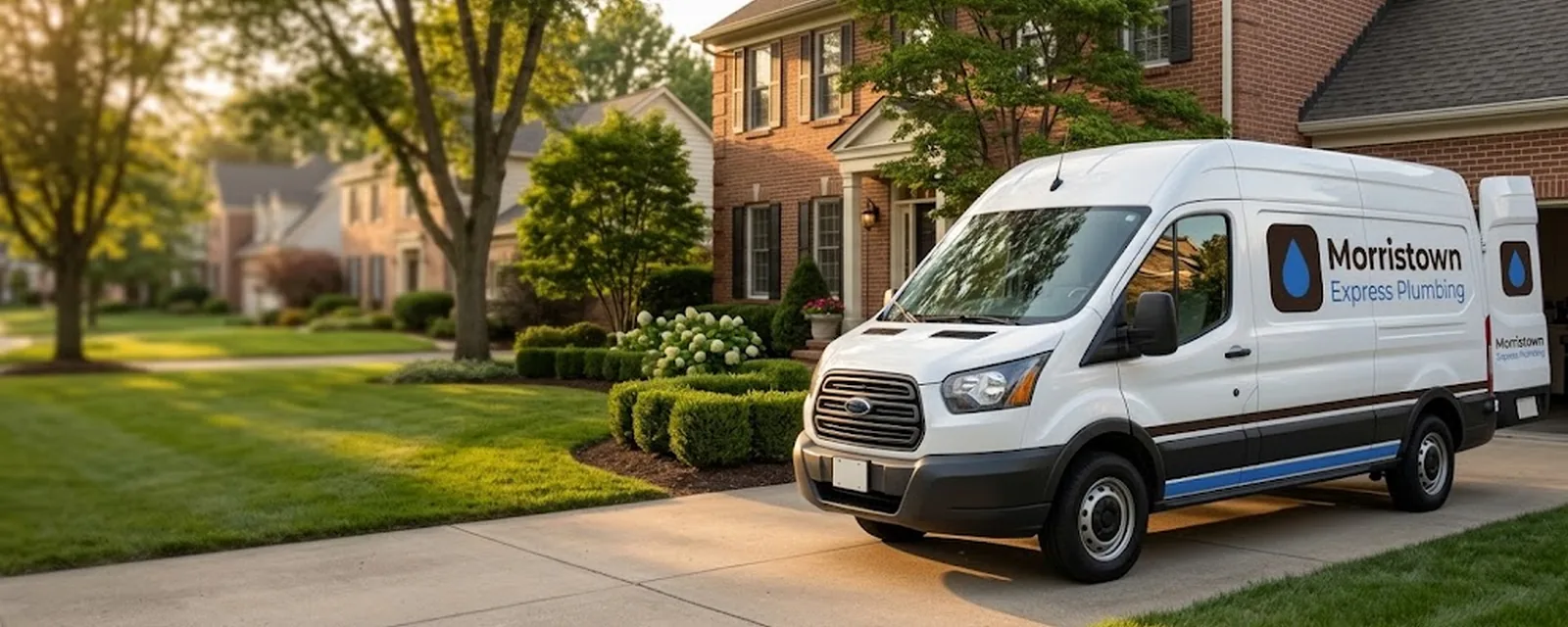
If you own or rent in the Morristown Historic District, you are living or working in one of the oldest built-up areas of Morris County. The district was added to the National Register of Historic Places on October 30, 1973, and its boundary was enlarged on November 13, 1986, growing from 93 acres to 213 acres. After that expansion it counted 352 contributing buildings.
That history matters for plumbing in a practical way. A house or office that has stood here for a century or more has almost always had its pipes touched by several generations of owners, so the system behind the walls is rarely a single clean design. This page explains what that means when a drain slows down, a ceiling stains or the water heater quits, and what to ask before anyone opens a wall.
To talk through a problem in the district, call the Morristown line at (908) 357-1542. Tell us the address, roughly how old the building is and what you are seeing, and we will say what to check first.
What the district covers
According to the district's National Register listing summarized by Wikipedia, its boundaries run roughly along the cemetery, King Place, Madison Avenue and Colles Avenue, DeHart Street and North Park Place. The Morristown Green sits inside it, along with the county courthouse and the Morristown train station, which were added in 1986.
The listing names Greek Revival, Late Victorian, Classical Revival and Art Deco as its styles. Individual buildings include Macculloch Hall, built in 1810, the Vail Mansion, built in 1918, the Morristown and Morris Township Library, built in 1917, and The Kedge, built in 1870 as a summer cottage.
For you, the point is simple: buildings of that age have usually been repaired and altered many times, so ask for the plumber to confirm what is actually in your walls before pricing any large job.
The practical takeaway is that the district is mixed. Some addresses are single-family houses, some are churches or public buildings and some are offices, so the right plumbing approach depends on what your building is, not on the district name.
What we know, what is general, and what we cannot say
Verified local facts
- The district was listed on the National Register on October 30, 1973 and expanded on November 13, 1986, from 93 to 213 acres, per the National Park Service listing as summarized by Wikipedia.
- After the expansion it had 352 contributing buildings, including Macculloch Hall (1810) and the Vail Mansion (1918).
- Morristown water is supplied by the Southeast Morris County Municipal Utilities Authority.
General plumbing information
- Older buildings often have a mix of old and new pipe materials from repairs over time.
- Hidden leaks and buried drain problems can be found without large demolition using listening gear and a camera.
What we cannot say
- What pipe materials, ages or conditions exist at any specific address.
- Whether a given property is inside the district boundary or subject to local historic review.
- Which sewer system serves a particular street.
Older-building plumbing: what is general
We do not know what pipes are inside any particular house in the district, and we will not guess from the address. What we can say is general. Buildings from the 1800s and early 1900s often carry a mix of materials added over the decades. Cast iron or galvanized steel is sometimes found in older drain and supply runs, with copper and plastic added in later repairs.
The only way to know yours is to look. A sewer camera inspection shows the real condition of a buried drain line, and a leak detection visit finds a hidden supply leak without tearing open finished plaster. Both are worth asking about before you agree to a large repair.
- Slow drains in more than one fixture often point to the main line rather than one trap.
- A water stain that grows after rain is a different problem from one that grows when a fixture runs.
- Ask any plumber to show you the failed section or the camera footage before you approve replacement.
Call and describe it. We will talk through the next step for Morristown Historic District.
Before the plumber arrives at an older property
Know where your main water shutoff is. In older buildings it can be in a basement corner, behind a panel or near the street side of the foundation, and it may be stiff from years of not being turned. If a pipe is leaking, closing it slowly is better than forcing it.
Clear the area around the fixture or wall, move rugs and electronics out of the way and take photos of the damage for your records. If a ceiling is bulging with water, stay out from under it and let a plumber relieve it safely.
Repairs that fit a historic setting
Many fixes in the district can be done with little disturbance. A drain cleaning clears a stoppage without touching finished surfaces. A water heater replacement swaps one appliance for another in the same spot. A burst pipe repair often means opening a small access point rather than a whole wall.
If a repair would change the outside of a building, or if your property is a designated landmark, there may be review steps with the town. We cannot tell you whether your address falls under those rules, so check with Morristown's land use office before planning exterior work.
Water and sewer in Morristown
Water in Morristown is supplied by the Southeast Morris County Municipal Utilities Authority, and its water emergency line is 973-867-1758. Sewer service in town is handled through the municipal sewer utility, and some properties near the town edge may connect through the neighboring Morris Township system, so ask the town which one serves your street.
Morristown is a small town completely surrounded by Morris Township, so an address a few doors from the district edge can sit under a different utility arrangement than you expect.
Related plumbing pages
These services come up most often in Morristown Historic District:
Morristown Historic District is part of Morristown, which sits inside Morris Township. See all service areas or return to the Morristown homepage.
Morristown Historic District on the map
Frequently asked questions
The district is bounded roughly by the cemetery, King Place, Madison and Colles Avenues, DeHart Street and North Park Place, but we cannot confirm individual addresses. Check the National Register boundary or ask Morristown's land use office.
No. Many older homes have had parts of their plumbing replaced over time, so the real mix varies from house to house. A camera inspection or a look at exposed pipe in the basement tells you what you have.
Often yes. Listening equipment, moisture checks and a pressure test can narrow a hidden leak to a small area, so any opening can be small. Some leaks still need a wall opened to repair.
Morristown's retail water comes from the Southeast Morris County Municipal Utilities Authority. If water is off on your whole street or looks discolored, call the authority's emergency line at 973-867-1758 before assuming it is your plumbing.
Stop running water, keep floor drains and toilets unused and call us at (908) 357-1542. If more than one fixture backs up, the main drain line is the likely problem and a camera inspection is the next step.